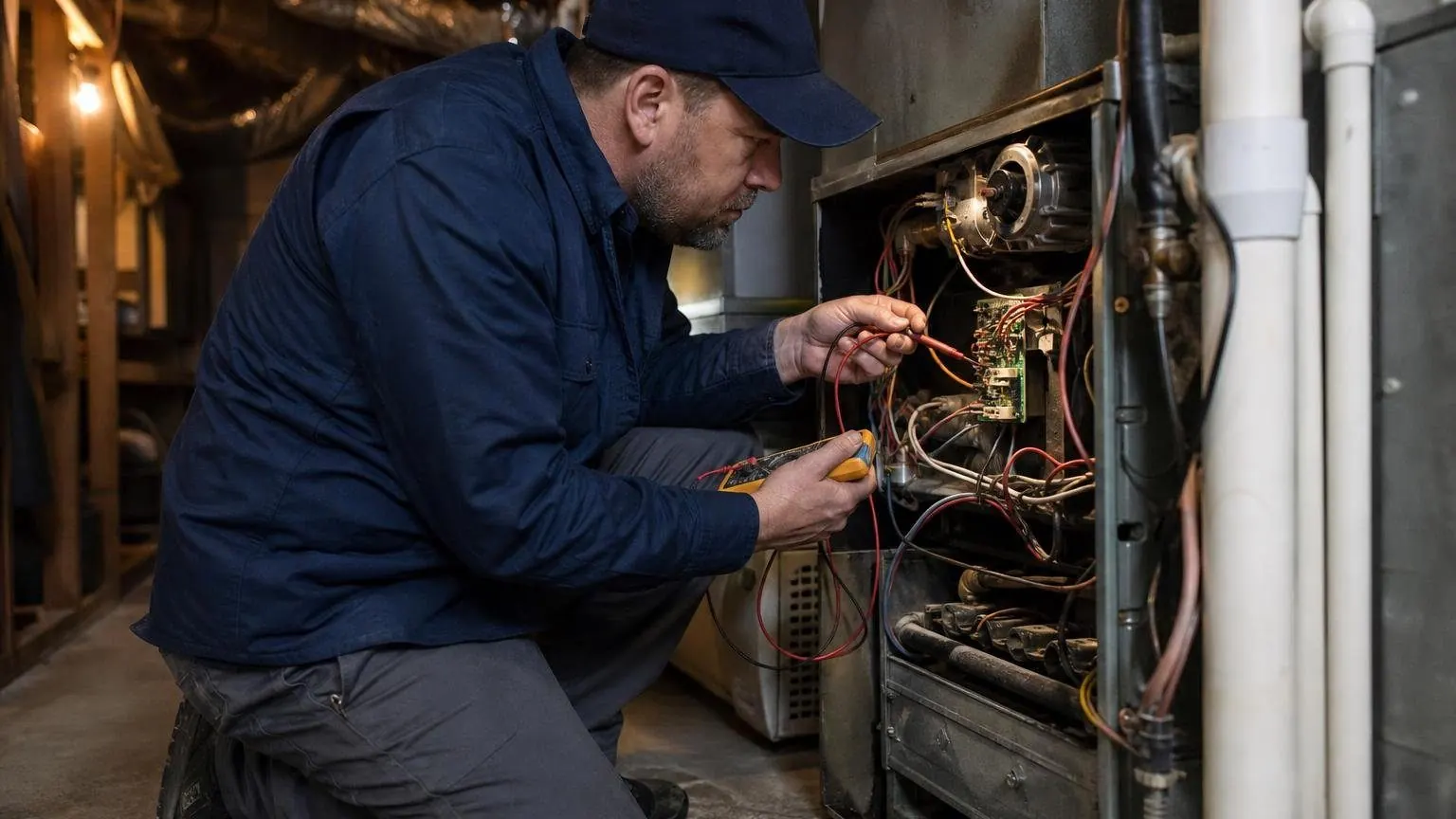
What is a furnace control board? A furnace control board is the circuit board that runs the heating sequence: it reads the thermostat, starts the inducer, checks the safety switches, lights the burners and times the blower. When something fails it flashes a code, and that code usually names a different part.
Key Takeaways
- Codes are board specific: a pressure switch that will not close is 31 on a White-Rodgers 50M56D-751, 2 on a Resideo S9200U1000 and E2 on older Goodman displays (EE2 on newer ones) (White-Rodgers instructions).
- The Resideo S9200U1000 universal board has a replaceable 3.0 amp automotive type fuse on the 24 volt side (Resideo specifications).
- Carrier’s code 24 “indicates fuse is open and there is a short in low-voltage wiring” (Carrier 58MVP guide).
- Goodman: 24 volts at the transformer but about 13 volts between R and C on the board means a blown fuse (Goodman RS6612022).
- The 50M56D-751 resets itself after 1 hour in lockout and keeps up to 5 fault codes for 14 days (White-Rodgers).
What does a furnace control board do?
A furnace control board, also sold as an integrated furnace control, is the 24 volt board that sequences a gas furnace. It takes the thermostat’s call for heat on the W terminal and switches the inducer, igniter, gas valve and blower in a fixed order, checking a safety input before each step. The board also times the blower run after the burners stop, so a furnace that does not turn off right away is often just finishing that delay.
The White-Rodgers 50M56D-751 instructions print the order for that Carrier replacement board: a 15 second pre-purge, igniter warm-up, a 3 second ignition period, then the blower after a 45 second default delay. Resideo’s S9200U1000 uses a 30 second prepurge and allows three ignition trials. If the pressure switch never proves draft or the flame is not sensed, the board stops and flashes a fault. After a power outage the board restarts this whole sequence from the top, so a furnace not working after a power outage may only need a few minutes.
Our walk through where an ignition sequence stops follows the same chain.
Where is the furnace control board located?
On many upflow gas furnaces the control board is mounted in the blower compartment, behind the lower door. On Goodman’s GM9S92 and GM9S96 family the status display is read “through the sight glass in the blower compartment door” (Goodman RS6612022), so the code can be read with the door on. Amana furnaces built on the same chassis read the same way, and the Amana furnace error codes show that the IdL readout on those displays is normal idle, not a fault. Reading the code before the panel comes off matters, because the furnace door switch cuts line power to the control the moment the blower door is pulled, and the stored code goes with it.
Read the code first. Goodman fits a door interlock switch that “interrupts unit voltage when the blower door is opened,” and the manual says: “Do not defeat this switch.” Pulling the door cuts power and the light goes dark. A door that is not fully seated does the same thing and leaves the blower dead, one of the first checks in furnace blower not turning on, along with a blown board fuse. Ductless systems have the same trap, and the Daikin mini split error codes are read from the remote before any power cycle, since the wall unit only blinks its lamp.
Safety before you touch the board
The board switches 120 volt loads and controls a gas valve. Each of those loads closes a relay with an audible click, which is why a furnace clicking but not turning on is read by counting the clicks and what follows them. Turn the furnace off at its service switch before removing panels. Resideo warns that “static discharge can damage the integrated furnace control” and says to touch bare appliance metal first (Resideo S9200U1000). Never jumper a safety switch to make a code go away.
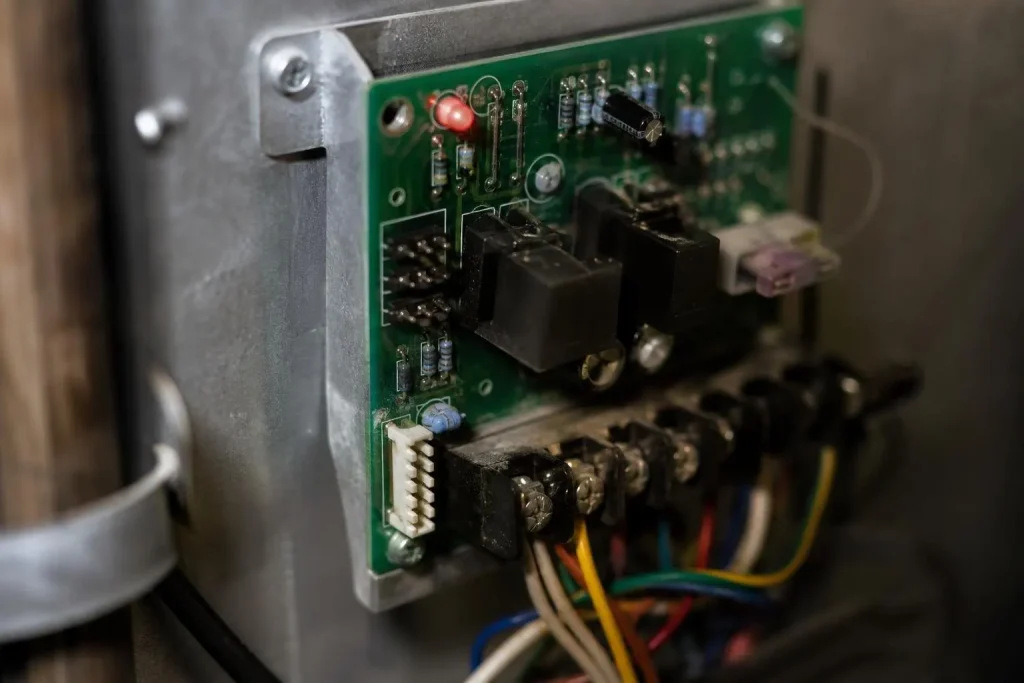
What do furnace control board blinking codes mean?
Furnace control board blinking codes are fault numbers; the same number means different things on different boards. Count the flashes, then match them to the chart inside the blower door or in the furnace manual. That chart governs. Carrier boards, for example, pair short and long flashes into a two digit number, as the Carrier furnace error codes table lays out. American Standard display boards add status words that only look like faults, which the American Standard furnace error codes separate from the real E codes.
Counting differs by maker. On the White-Rodgers 50M56D-751, two-digit codes are short flashes then long flashes, so ignition failure is “3 short flashes followed by 4 long flashes.” The Resideo S9200U1000 flashes X times at 2Hz, pauses one second, then flashes Y times. Goodman and Rheem’s 801T furnaces print the number on a seven-segment display instead. Rheem and Ruud furnaces have used more than one control board, so the Rheem furnace error codes are sorted by board. Frigidaire furnaces need the same care, because their Nordyne, UTEC and Emerson boards each have their own chart in the Frigidaire furnace error codes.
| Fault | Goodman RS6612022 (display) | White-Rodgers 50M56D-751 (red LED) | Resideo S9200U1000 (red LED) | Rheem 801T (display) | Usually points to |
|---|---|---|---|---|---|
| Pressure switch did not close | E2 | 31 | 2 | 57 | Pressure switch, hose, vent, inducer |
| Pressure switch stuck closed | E1 | 23 | 3 | 55 | Switch contacts, shorted wiring |
| Limit open | E3 | 33 (limit or rollout) | 5 | 22 | Filter, blower, airflow |
| Ignition lockout or failed ignition | E0 | 34; 32 if igniter fails | 2+1 | 11 | Igniter, gas supply, flame sensor |
| Weak flame signal | E6 | 41 (amber) | Amber periodic blink | 12 | Flame sensor |
| Low voltage fuse open | E5 | 24 | 3+2 | Not listed | Shorted 24 V wire |
| Control itself failed | See chart | Solid red: internal fault | 3+5 | Not listed | The board |
Each column comes only from the named document; other boards from the same brand use other codes.
Limit codes usually trace to the limit switch and the airflow behind it, and weak flame codes to a coated flame sensor.
Ignition lockouts point to the hot surface igniter first, then the gas valve and its wiring.
A blinking light is not always a fault. On the 50M56D-751, amber code 42 means normal heat mode and solid green means standby. Light color can carry the fault itself, and on Coleman manufactured home furnaces the green light is the one that blinks the code, per the Coleman furnace error codes. On the S9200U1000, a red “heartbeat” pulse means a normal call for heat.
Why does the furnace control board fuse keep blowing?
A furnace control board fuse blows because something on the 24 volt side is shorted. A smart thermostat is often the first thing to report it, and Nest no power to Rh wire traces that alert back to a blown board fuse, a tripped float switch, a loose red wire or a dead transformer. Carrier’s fault code 24 “indicates fuse is open and there is a short in low-voltage wiring” (Carrier 58MVP guide), and Goodman’s chart pairs “Open fuse” with “Locate and correct short in low voltage wiring.”
Carrier’s isolation steps point first at the thermostat circuit. They end at “a defective thermostat or a short circuit in wiring between thermostat and furnace,” or the same short on the run between thermostat and outdoor unit. Resideo adds limit, rollout and pressure switch wiring shorted to chassis, or a shorted gas valve (Resideo Table 12). Overheating in the cabinet can also announce itself by smell, and a fishy smell from vents that comes and goes with the blower sends the technician to the blower motor, its capacitor and scorched terminals on the control board or transformer.
Fuse size is printed on the fuse and in the board’s specifications. The Resideo S9200U1000 uses a “3.0 Amp, Automotive type” fuse, and Resideo says to replace it “with a fuse of the same type.” Do not substitute a larger one. Goodman’s older single-stage LED boards flash six times for a rollout trip or an open board fuse.
A technician isolates the short like this:
- Confirm 24 volts at the transformer, then measure R to C at the board. Goodman says about 13 volts there means a blown fuse (Goodman RS6612022).
- Disconnect the thermostat wires at the board and fit a new fuse of the same rating.
- Reconnect and call for heat, then cooling. A fuse that blows only on cooling points to the outdoor unit run.
See our guides to thermostat wire colors and terminals and to a thermostat that has gone blank.
How do you tell if a furnace control board is bad?
A furnace control board is bad only after everything around it checks good: correct power in, safety switches proving, and an output that still will not switch. Resideo’s rule: “If any component does not function properly, make sure it is correctly installed and wired before replacing it” (Resideo S9200U1000).
- Record the code and history before any reset.
- Check power in. Goodman checks 120 volts line to neutral at the board, then 24 volts from W to C on a call for heat.
- Test the part the code names. In the table above, six of seven faults point away from the board.
- Check polarity and ground. Goodman notes that reversed polarity, a missing earth ground or a poor neutral “may cause the control to lockout due to failure to sense flame.” Resideo flags it as 3+6.
- Look for board codes and dead outputs. White-Rodgers lists a solid red LED as an internal fault and says to replace the control. Resideo says a status LED that keeps blinking fast, 8 pulses a second, after startup means the control has failed. Goodman: with line and 24 volt power present, no 120 volts at the inducer output means replace the ignition control.
A manual reset is possible: the White-Rodgers sheet says removing 24 VAC for more than 10 seconds resets the control (White-Rodgers). A reset clears a lockout, not the cause; see our guide on resetting a furnace safely.
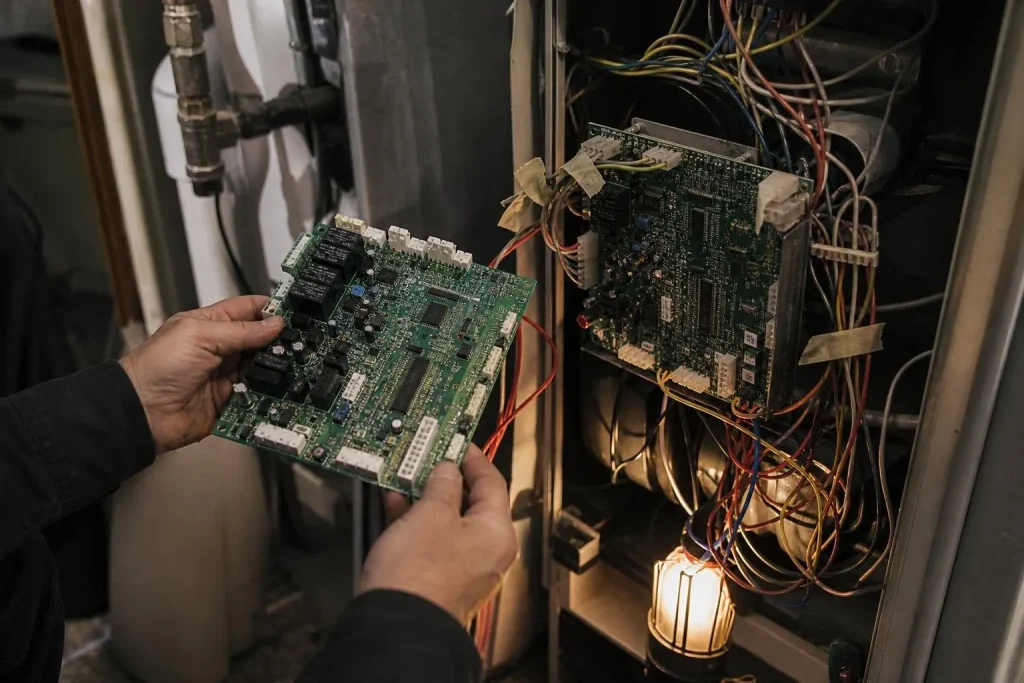
Can a universal board replace your furnace control board?
Often, yes. A universal board is built to replace other makers’ controls: Resideo says keyed wire harnesses let the S9200U1000 “replace most furnace controls” in single stage gas appliances (Resideo S9200U1000). Brand kits are narrower: the White-Rodgers 50M56D-751 is a direct replacement for Carrier single stage furnaces with PSC blower motors.
Both documents follow the same pattern:
- Find the old board in the new board’s cross-reference table.
- Record the old board’s safety timings and DIP switch settings. Resideo says to identify them “before any wires are disconnected.”
- Mark every wire that is not on a plug, then remove the old board.
- Mount the new board so its screws give a solid chassis ground, as White-Rodgers requires.
- Connect the keyed harnesses without forcing them, then set the DIP switches.
- Restore power and gas, then verify heating, cooling and fan operation.
Resideo states that “only trained, experienced service technicians should service integrated furnace control systems,” and ENERGY STAR’s tune-up list asks a technician to “check controls of the system to ensure proper and safe operation” (ENERGY STAR checklist). After any gas-side repair, check that CO alarms sit where they belong.
On cost, we print no figure. No federal or national-lab series publishes control board repair prices, the gap our review of what repair cost data actually measures found.
How we researched this
Researched October 9, 2026. We read and cite the Goodman RS6612022 service manual, the White-Rodgers 50M56D-751 instructions, the Resideo S9200U1000 instructions, Rheem’s 801T installation manual, a third-party copy of Carrier’s 58MVP troubleshooting guide, and the ENERGY STAR maintenance checklist. Excluded: generic code lists and repair prices on contractor and content sites, which cite no manufacturer document. Reddit was skipped: this is a gas and electrical safety topic. Goodman’s RS6612023 service manual says to replace the board fuse with a 3-amp automotive type, the same rating Resideo lists.
Frequently asked questions
What size fuse is on a furnace control board?
It depends on the board, and the rating is printed on the fuse. The Resideo S9200U1000 universal control specifies a replaceable 3.0 amp automotive type fuse, and Resideo says to replace it with a fuse of the same type. Never fit a higher rating.
Why is my furnace blinking a red light 3 times?
It depends on the board. On a Resideo S9200U1000, a single group of 3 red flashes means the pressure switch failed closed. On a White-Rodgers 50M56D-751, 3 short flashes are only the first digit of a two-digit code from 31 to 34. Check the chart on your blower door.
Can a bad thermostat blow the furnace control board fuse?
Yes. Carrier’s troubleshooting for code 24, secondary voltage fuse open, ends at a defective thermostat or a short circuit in the wiring between the thermostat and the furnace or the outdoor unit. Fix the short before fitting a new fuse, or the replacement will blow too.
How do I reset a furnace control board?
Cycling low voltage power works on many boards. The White-Rodgers 50M56D-751 resets when 24 VAC is removed for more than 10 seconds and resets itself after 1 hour in lockout. The Resideo S9200U1000 restarts after 60 minutes in soft lockout. A reset does not fix the cause.
Can a furnace control board be repaired?
Manufacturers say replace it. Resideo’s instructions state that the S9200U1000 cannot be repaired and that a malfunctioning control should be replaced. A failed board is swapped for the furnace maker’s part or a universal kit listed in that kit’s cross-reference table.
How much does a furnace control board replacement cost?
We print no number because no federal or national-lab source publishes one. Ask for a written quote that names the replacement part, such as an OEM board or a universal kit like the Resideo S9200U1000, and the meter reading that showed the old board failed.
Sources
- Daikin Comfort Technologies (Goodman). “Service and Troubleshooting GM9S92 / GM9S96 / GC9S96 Single Stage Gas Furnaces (RS6612022r1).” https://mobile.goodmanmfg.com/mobileapp/stellent/pdf/infoPdf/Lit/RS6612022R1.pdf Accessed October 2026.
- Copeland (White-Rodgers). “50M56D-751 Carrier Integrated Single Stage Ignition Control Kit, Installation Instructions.” https://media.copeland.com/7b1c16cb-45cd-45fe-8e23-b16b0109fc57/0037-7757001%20-%2050M56D-751%20Instruction%20Sheet%20(EF).pdf Accessed October 2026.
- Resideo. “S9200U1000 Universal Hot Surface Ignition Integrated Furnace Control, Installation Instructions (69-2075).” https://www.cochranesupply.com/media/assets/product/documents/Honeywell/S9200U1000.pdf Accessed October 2026.
- Rheem. “Installation Instructions, (-)801T Upflow Series Gas Furnaces.” https://resource.gemaire.com/is/content/Watscocom/Gemaire/rheem_r801t_en_ii.pdf Accessed October 2026.
- Carrier. “58MVP Service and Troubleshooting Guide (Form 58MVP-8SM),” third-party copy, pages 19 and 20. https://www.manualsdir.com/manuals/63165/carrier-58mvp.html?page=19 Accessed October 2026.
- ENERGY STAR. “Maintenance Checklist.” https://www.energystar.gov/saveathome/heating-cooling/maintenance-checklist Accessed October 2026.
Leave a Reply